Reading contract
What the chapter note asks the reader to do.
Chapter thesis
Reinforcement learning adds numeric adaptation to Soar's symbolic control: the architecture can tune procedural choices through reward while still operating through operators and preferences.
Explain how reinforcement learning tunes operator preferences in Soar, compare that tuning with chunking, and identify why large state spaces and incomplete value functions complicate the story.
Learning objectives
- Explain the value-function role in operator selection.
- Distinguish numeric preference tuning from chunk creation.
- Describe how RL updates interact with substates.
- Evaluate large-state-space and incomplete-value-function limitations.
Architectural problem
The problem this chapter adds to the course argument.
Procedural knowledge can specify what is possible, but agents also need to improve which choices they prefer. Chapter 7 asks how Soar can learn control preferences from reward and experience.
Key idea 1
RL modifies how operators are evaluated, not the basic cycle itself.
RL tunes preferences rather than explaining new rules from reasoning.
Key idea 2
Symbolic and numeric operator-evaluation rules can coexist.
Numeric values enter the same operator-selection discipline.
Key idea 3
Model-free and model-based distinctions clarify what kind of learning is occurring.
State-space design controls what can be learned efficiently.
Key idea 4
State abstraction and incomplete values are central limitations.
Chapter 7 should be read beside Chapter 6, not after it as a replacement.
Mechanism map
A generated diagram and step sequence for the chapter mechanism.
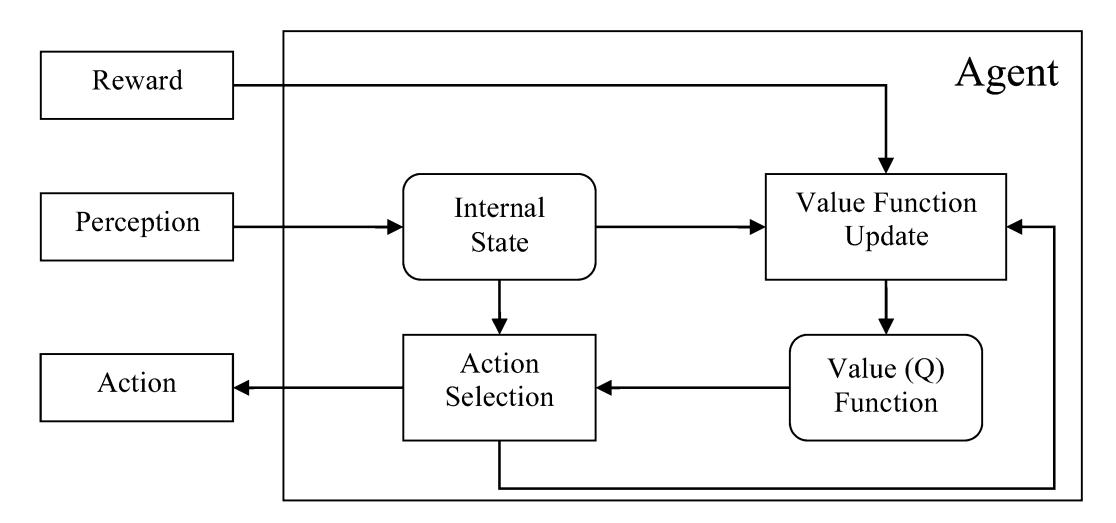
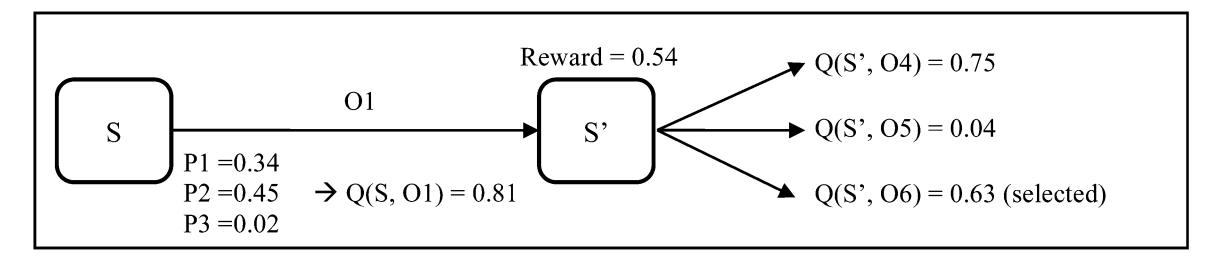
Soar reinforcement learning represents value information in rules that contribute numeric preferences. Updates adjust those values based on reward, allowing operator selection to improve over time while remaining integrated with symbolic proposal and evaluation.
Mechanism sequence
- Represent candidate operators symbolically.
- Attach numeric value information through RL rules.
- Select operators using combined preference evidence.
- Receive reward or feedback.
- Update value estimates.
- Use changed preferences in later decisions.
Polymathic lenses
How the chapter reads across cognitive science, AI architecture, learning, memory, and practice.
| Lens | Use in lecture |
|---|---|
| Learning | RL tunes preferences rather than explaining new rules from reasoning. |
| Control | Numeric values enter the same operator-selection discipline. |
| Representation | State-space design controls what can be learned efficiently. |
| Comparison | Chapter 7 should be read beside Chapter 6, not after it as a replacement. |
Figures and evidence
Book figures and page anchors that should ground the lecture.

| Claim | Source | Use in lecture | Limit |
|---|---|---|---|
| The chapter introduces reinforcement learning in Soar. | PDF page 186 | Grounds the mechanism. | Lecture synthesis should cite this anchor and avoid replacing the source chapter. |
| The chapter covers value representation and updating RL rules. | PDF page 191 | Supports the preference-loop diagram. | Lecture synthesis should cite this anchor and avoid replacing the source chapter. |
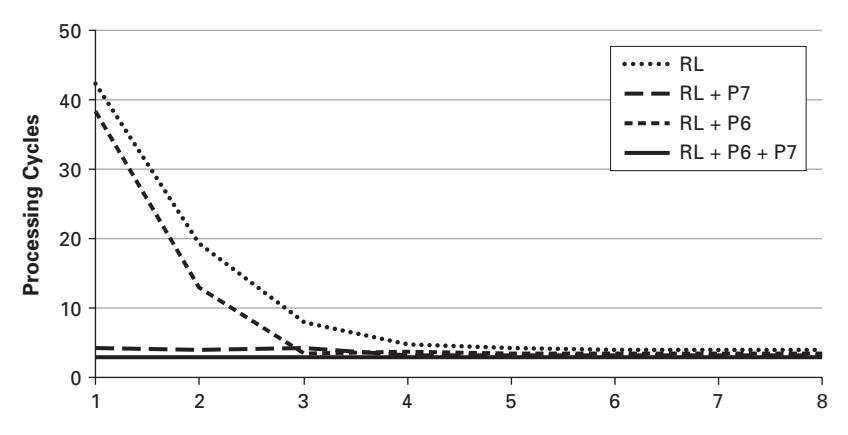
| The chapter discusses large state spaces and incomplete value functions. | PDF page 198 | Supports limitations and assumptions. | Lecture synthesis should cite this anchor and avoid replacing the source chapter. |
Tensions and assumptions
Where the chapter should provoke careful interpretation.
Hybrid strength
Symbolic proposal and numeric tuning can cooperate.
The architecture does not have to choose between structured operators and reward-sensitive choice.
Scaling pressure
Large state spaces make value learning fragile.
The usefulness of RL depends on representation, abstraction, and whether enough value information exists.
Assumption register
- Lecture explanations paraphrase and synthesize the chapter rather than reproducing it.
- Generated diagrams are instructor-created interpretive diagrams, not copied book figures.
- Claims about modern relevance should be treated as course synthesis unless a later source is added.
Seminar exercise
A concrete activity to turn reading into usable understanding.
Applied task
Create a two-operator choice and specify how a symbolic preference and a learned numeric preference would combine. Then explain what reward would change after three trials.
Use the source anchors above when defending the answer.
- Does RL in Soar feel like an add-on or a natural extension of preferences?Q1
Prepare an answer with at least one source anchor or a clearly labeled inference.
- What does symbolic structure buy in large reinforcement-learning spaces?Q2
Prepare an answer with at least one source anchor or a clearly labeled inference.
- How should a modeler decide between chunking and RL for a recurring behavior?Q3
Prepare an answer with at least one source anchor or a clearly labeled inference.
| Moment | Action | Owner |
|---|---|---|
| Before class | Read the chapter note and inspect selected figures. | Student |
| During class | Diagram one mechanism step without notes. | Seminar group |
| After class | Add one claim-evidence-limit row to the course matrix. | Student |
Sources
Trace lecture claims to page anchors, extracted figures, and generated project files.
Reviewed sources
- Chapter 7 - Tuning Procedural Knowledge: Reinforcement Learning chapter anchor
- Printed start 181; PDF pages 186-207.
- Chapter 7 - Tuning Procedural Knowledge: Reinforcement Learning opening page
- Primary opening source for the chapter note.
- Chapter 7 - Tuning Procedural Knowledge: Reinforcement Learning closing page
- End of the chapter page range used for synthesis and review.
- Selected figure 1 from Chapter 7 - Tuning Procedural Knowledge: Reinforcement Learning
- Extracted image on PDF page 187.
- Selected figure 2 from Chapter 7 - Tuning Procedural Knowledge: Reinforcement Learning
- Extracted image on PDF page 191.
- Selected figure 3 from Chapter 7 - Tuning Procedural Knowledge: Reinforcement Learning
- Extracted image on PDF page 192.
- Selected figure 4 from Chapter 7 - Tuning Procedural Knowledge: Reinforcement Learning
- Extracted image on PDF page 197.
- The chapter introduces reinforcement learning in Soar.
- Grounds the mechanism.
- The chapter covers value representation and updating RL rules.
- Supports the preference-loop diagram.
- The chapter discusses large state spaces and incomplete value functions.
- Supports limitations and assumptions.