Reading contract
What the chapter note asks the reader to do.
Chapter thesis
Episodic memory gives Soar access to experienced situations, allowing the architecture to use past events as resources for perception, reasoning, and action without reducing them to timeless facts.
Synthesize why episodic memory is architecturally different from semantic memory, then explain how remembered experience can support familiarity, novelty detection, virtual sensing, action modeling, and future reasoning.
Learning objectives
- Differentiate episodic and semantic memory by use, content, and retrieval role.
- Explain how episodic retrieval supports perception and reasoning.
- Identify when experience memory can improve action choice.
- Surface the risk of over-relying on retrieved episodes.
Architectural problem
The problem this chapter adds to the course argument.
Agents need more than general facts. They also benefit from remembering what happened, where, when, and with what consequences. Chapter 9 asks how an architecture can use experience without confusing it with semantic knowledge.
Key idea 1
Episodic memory is experience-centered rather than fact-centered.
Episodes preserve situated experience.
Key idea 2
Retrieved episodes can function like evidence, simulation material, or warning signals.
Familiarity and novelty can be influenced by recall.
Key idea 3
Experience memory expands what the agent can notice and infer.
Past successes and failures can become current evidence.
Key idea 4
Comparison with semantic memory is the central interpretive task.
Semantic memory abstracts knowledge; episodic memory recalls experience.
Mechanism map
A generated diagram and step sequence for the chapter mechanism.
Episodic memory encodes and stores snapshots or traces of experience, then retrieves relevant past episodes for current use. The mechanism supports familiarity, novelty, repetition detection, virtual sensing, action modeling, and recall of previous successes or failures.
Mechanism sequence
- Experience is encoded during ongoing processing.
- Episodes are stored with contextual structure.
- Current cues trigger retrieval.
- Retrieved experience informs perception, reasoning, or action modeling.
- The agent uses the result in the ordinary Soar cycle.
Polymathic lenses
How the chapter reads across cognitive science, AI architecture, learning, memory, and practice.
| Lens | Use in lecture |
|---|---|
| Memory | Episodes preserve situated experience. |
| Perception | Familiarity and novelty can be influenced by recall. |
| Reasoning | Past successes and failures can become current evidence. |
| Comparison | Semantic memory abstracts knowledge; episodic memory recalls experience. |
Figures and evidence
Book figures and page anchors that should ground the lecture.
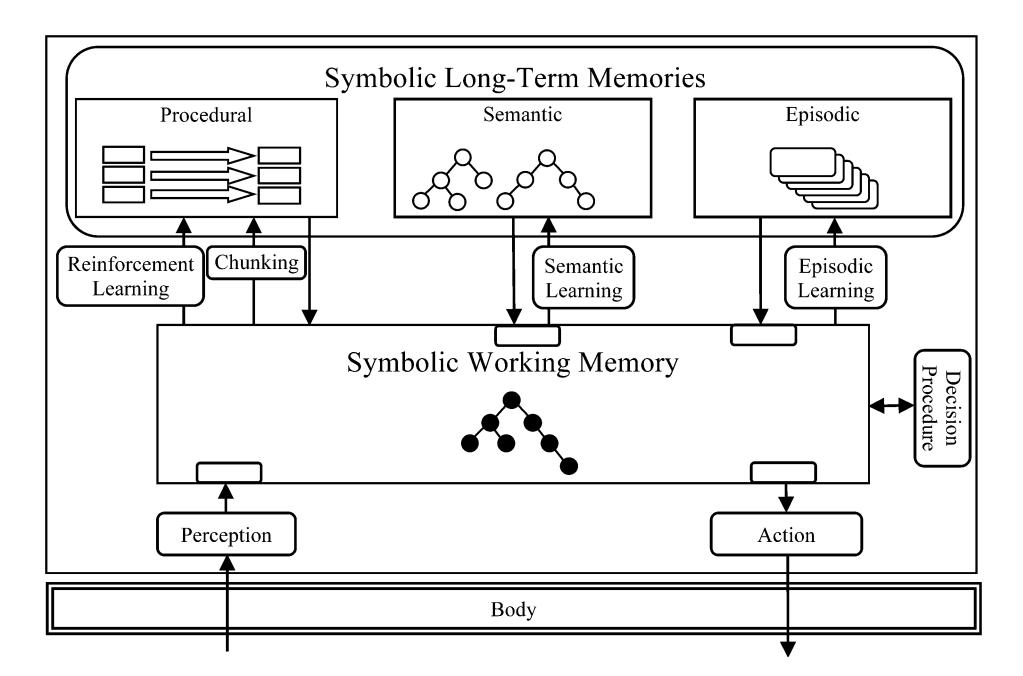
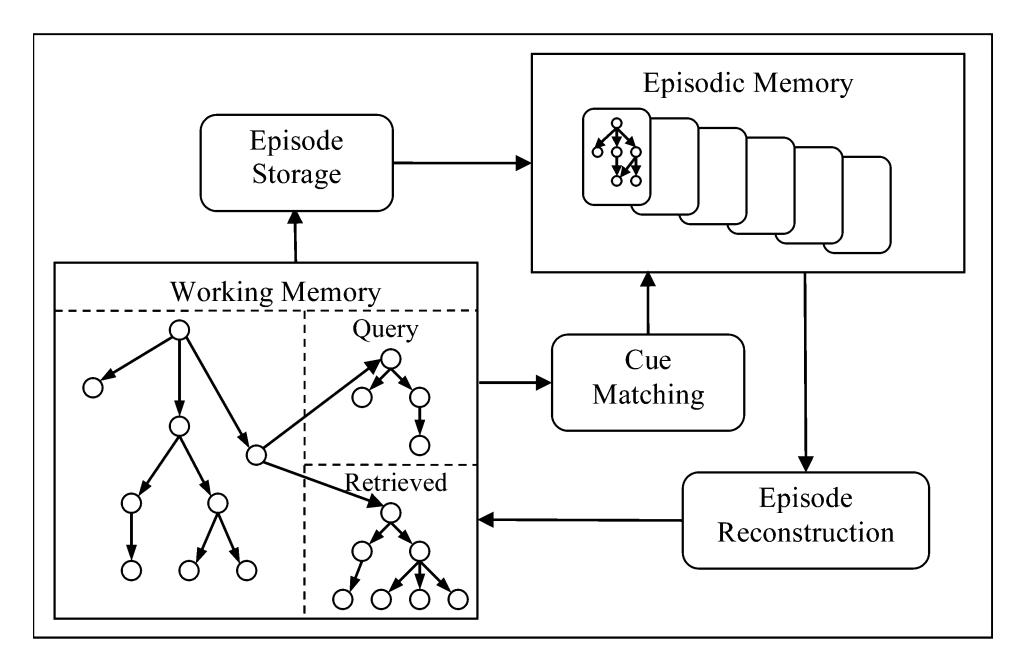
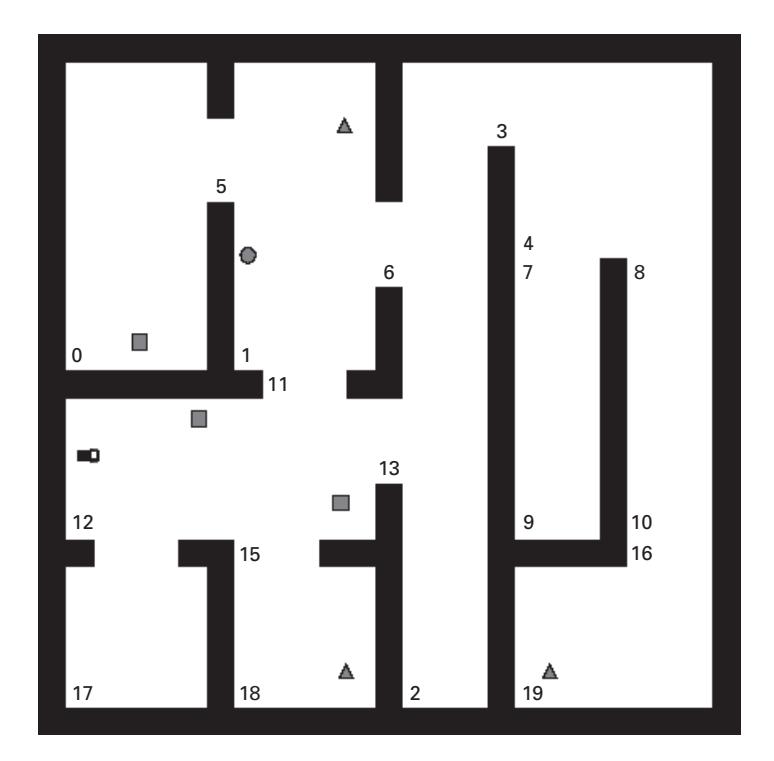
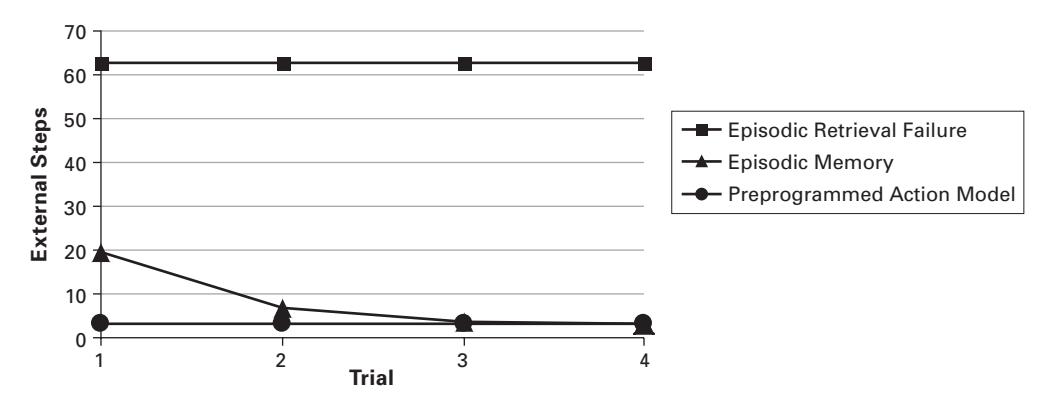
| Claim | Source | Use in lecture | Limit |
|---|---|---|---|
| The chapter introduces episodic memory after semantic memory. | PDF page 230 | Grounds the comparison. | Lecture synthesis should cite this anchor and avoid replacing the source chapter. |
| Encoding and storage are treated explicitly. | PDF page 232 | Supports the memory-cycle diagram. | Lecture synthesis should cite this anchor and avoid replacing the source chapter. |
| The chapter discusses uses including perception and reasoning. | PDF page 240 | Supports the polymathic lens section. | Lecture synthesis should cite this anchor and avoid replacing the source chapter. |
Tensions and assumptions
Where the chapter should provoke careful interpretation.
Experience leverage
Past situations can guide current reasoning.
Episodic memory gives the architecture access to concrete prior contexts.
Experience limit
A remembered episode is not automatically a general rule.
The lecture should keep episode-based reasoning distinct from semantic facts and learned productions.
Assumption register
- Lecture explanations paraphrase and synthesize the chapter rather than reproducing it.
- Generated diagrams are instructor-created interpretive diagrams, not copied book figures.
- Claims about modern relevance should be treated as course synthesis unless a later source is added.
Seminar exercise
A concrete activity to turn reading into usable understanding.
Applied task
Create a table with one semantic-memory retrieval and one episodic-memory retrieval for the same task. Explain how each changes the agent's next operator decision.
Use the source anchors above when defending the answer.
- When should a past episode be treated as evidence?Q1
Prepare an answer with at least one source anchor or a clearly labeled inference.
- What is lost when experience is converted into semantic knowledge?Q2
Prepare an answer with at least one source anchor or a clearly labeled inference.
- How can episodic retrieval mislead an agent?Q3
Prepare an answer with at least one source anchor or a clearly labeled inference.
| Moment | Action | Owner |
|---|---|---|
| Before class | Read the chapter note and inspect selected figures. | Student |
| During class | Diagram one mechanism step without notes. | Seminar group |
| After class | Add one claim-evidence-limit row to the course matrix. | Student |
Sources
Trace lecture claims to page anchors, extracted figures, and generated project files.
Reviewed sources
- Chapter 9 - Episodic Memory chapter anchor
- Printed start 225; PDF pages 230-251.
- Chapter 9 - Episodic Memory opening page
- Primary opening source for the chapter note.
- Chapter 9 - Episodic Memory closing page
- End of the chapter page range used for synthesis and review.
- Selected figure 1 from Chapter 9 - Episodic Memory
- Extracted image on PDF page 232.
- Selected figure 2 from Chapter 9 - Episodic Memory
- Extracted image on PDF page 233.
- Selected figure 3 from Chapter 9 - Episodic Memory
- Extracted image on PDF page 240.
- Selected figure 4 from Chapter 9 - Episodic Memory
- Extracted image on PDF page 244.
- The chapter introduces episodic memory after semantic memory.
- Grounds the comparison.
- Encoding and storage are treated explicitly.
- Supports the memory-cycle diagram.
- The chapter discusses uses including perception and reasoning.
- Supports the polymathic lens section.