Reading contract
What the chapter note asks the reader to do.
Chapter thesis
Chapter 11 matters because it asks whether emotion can be integrated with the same control architecture that handles reasoning and learning, rather than modeled as a separate overlay.
Evaluate emotion as an architectural integration problem by relating appraisal, mood, feeling, reinforcement learning, and cognitive control without treating affect as a disconnected add-on.
Learning objectives
- Explain appraisal as an architectural control issue.
- Distinguish emotion, mood, and feeling at a lecture level.
- Relate affective dynamics to reinforcement learning.
- Assess what demonstrations can and cannot prove about emotion in Soar.
Architectural problem
The problem this chapter adds to the course argument.
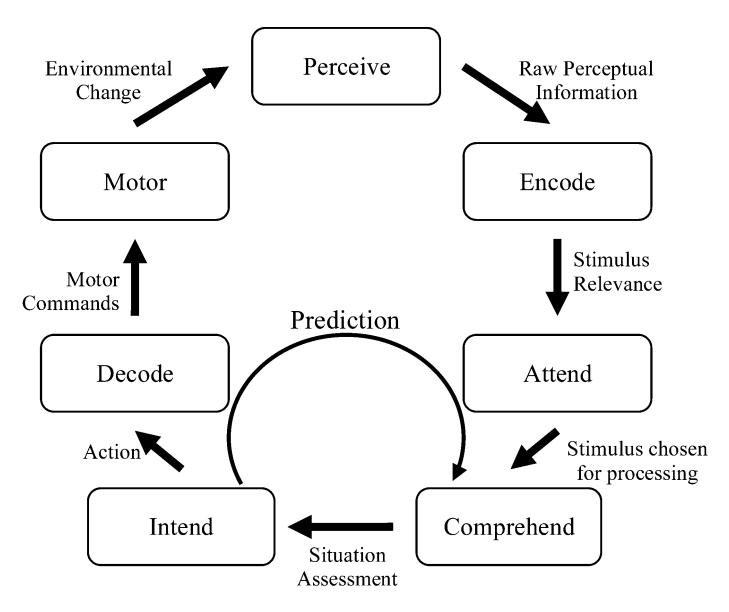
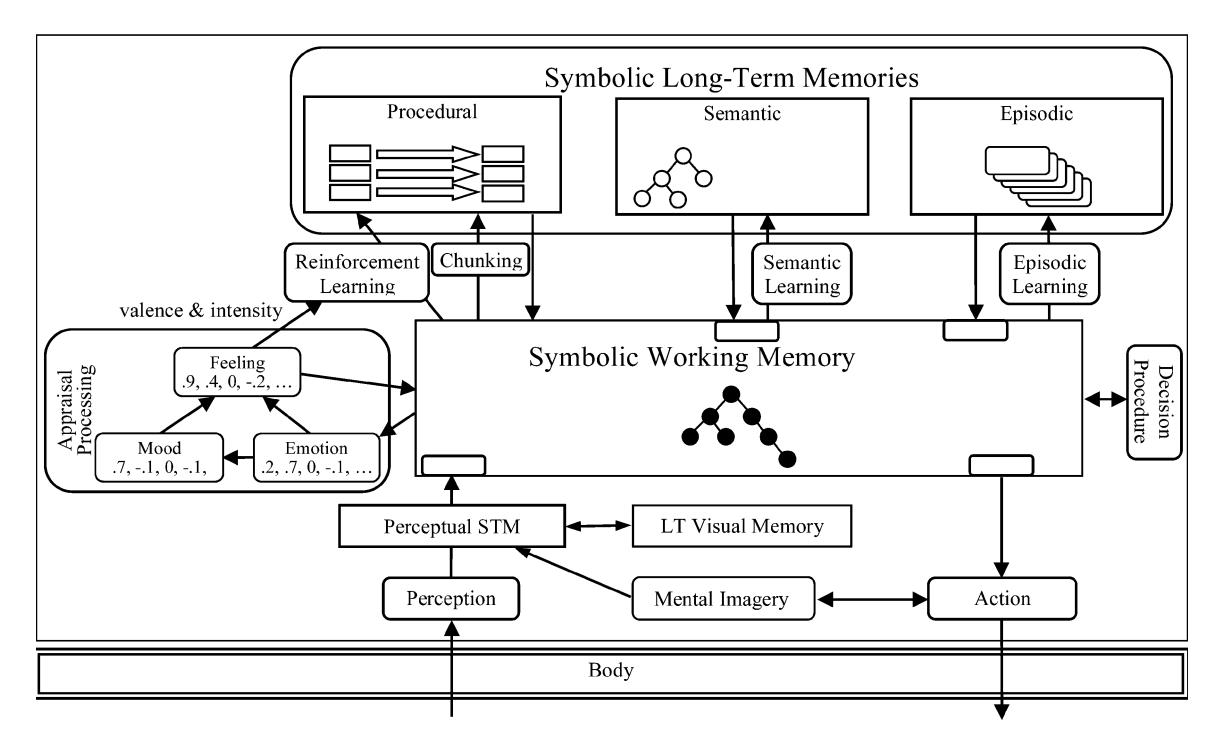
Emotion is difficult for a cognitive architecture because it touches evaluation, control, learning, bodily or affective state, and subjective interpretation. The chapter asks how appraisal and affective dynamics can interact with Soar mechanisms.
Key idea 1
Emotion is treated as integrated with control, not outside cognition.
Emotion changes what the agent evaluates and prioritizes.
Key idea 2
Appraisal connects situation interpretation with affective response.
Appraisal links representation to action tendency.
Key idea 3
Reinforcement learning provides one bridge between emotion and action selection.
RL gives emotion a route into future preference.
Key idea 4
The chapter raises adequacy questions that are more open than many mechanism chapters.
Feeling and functional control should not be collapsed.
Mechanism map
A generated diagram and step sequence for the chapter mechanism.
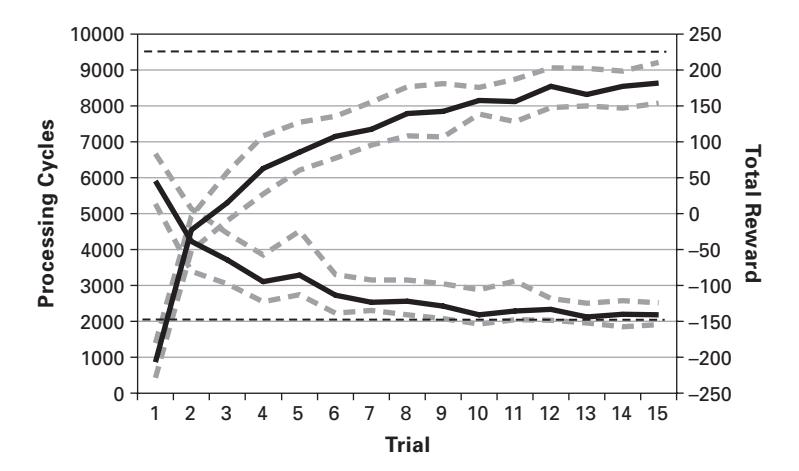
The chapter relates cognitive control and appraisal, distinguishes emotion, mood, and feeling, connects emotion to reinforcement learning, and presents demonstrations that test whether affective processing can be architecturally grounded.
Mechanism sequence
- A situation is represented in working memory.
- Appraisal interprets significance for the agent.
- Affective state influences control or valuation.
- Learning mechanisms can update preferences or expectations.
- Behavior changes and creates new appraisal conditions.
Polymathic lenses
How the chapter reads across cognitive science, AI architecture, learning, memory, and practice.
| Lens | Use in lecture |
|---|---|
| Affect | Emotion changes what the agent evaluates and prioritizes. |
| Control | Appraisal links representation to action tendency. |
| Learning | RL gives emotion a route into future preference. |
| Philosophy | Feeling and functional control should not be collapsed. |
Figures and evidence
Book figures and page anchors that should ground the lecture.
| Claim | Source | Use in lecture | Limit |
|---|---|---|---|
| The chapter addresses cognitive control and appraisal. | PDF page 275 | Grounds the integration question. | Lecture synthesis should cite this anchor and avoid replacing the source chapter. |
| Emotion, mood, and feeling are treated as distinct topics. | PDF page 279 | Supports the vocabulary section. | Lecture synthesis should cite this anchor and avoid replacing the source chapter. |
| The chapter connects emotion and reinforcement learning. | PDF page 285 | Supports the RL bridge. | Lecture synthesis should cite this anchor and avoid replacing the source chapter. |
Tensions and assumptions
Where the chapter should provoke careful interpretation.
Integration claim
Emotion can be connected to appraisal and control.
The chapter shows a path for making affect architecturally consequential.
Adequacy question
A computational integration is not the whole theory of emotion.
The lecture should keep implementation, psychological adequacy, and phenomenology distinct.
Assumption register
- Lecture explanations paraphrase and synthesize the chapter rather than reproducing it.
- Generated diagrams are instructor-created interpretive diagrams, not copied book figures.
- Claims about modern relevance should be treated as course synthesis unless a later source is added.
Seminar exercise
A concrete activity to turn reading into usable understanding.
Applied task
Choose one appraised situation and specify how it would affect operator evaluation, reward interpretation, or future preference. Label what is implemented and what remains theoretical.
Use the source anchors above when defending the answer.
- Does appraisal belong inside the central control loop?Q1
Prepare an answer with at least one source anchor or a clearly labeled inference.
- Which part of emotion is most naturally architectural?Q2
Prepare an answer with at least one source anchor or a clearly labeled inference.
- What would count as strong evidence for emotion processing in Soar?Q3
Prepare an answer with at least one source anchor or a clearly labeled inference.
| Moment | Action | Owner |
|---|---|---|
| Before class | Read the chapter note and inspect selected figures. | Student |
| During class | Diagram one mechanism step without notes. | Seminar group |
| After class | Add one claim-evidence-limit row to the course matrix. | Student |
Sources
Trace lecture claims to page anchors, extracted figures, and generated project files.
Reviewed sources
- Chapter 11 - Emotion chapter anchor
- Printed start 271; PDF pages 275-289.
- Chapter 11 - Emotion opening page
- Primary opening source for the chapter note.
- Chapter 11 - Emotion closing page
- End of the chapter page range used for synthesis and review.
- Selected figure 1 from Chapter 11 - Emotion
- Extracted image on PDF page 279.
- Selected figure 2 from Chapter 11 - Emotion
- Extracted image on PDF page 285.
- Selected figure 3 from Chapter 11 - Emotion
- Extracted image on PDF page 286.
- The chapter addresses cognitive control and appraisal.
- Grounds the integration question.
- Emotion, mood, and feeling are treated as distinct topics.
- Supports the vocabulary section.
- The chapter connects emotion and reinforcement learning.
- Supports the RL bridge.