Reading contract
What the chapter note asks the reader to do.
Chapter thesis
Applications show Soar's practical reach, but the lecture should treat them as scoped evidence: they demonstrate breadth, modeling practices, and task relevance without automatically settling the deeper architectural theory.
Use the applications chapter to judge what kinds of applied breadth Soar has demonstrated, while separating application success from proof that every architectural commitment is correct.
Learning objectives
- Identify major application categories.
- Connect applications to Soar mechanisms and requirements.
- Distinguish applied success from theoretical proof.
- Prepare for the final synthesis in Chapter 14.
Architectural problem
The problem this chapter adds to the course argument.
After technical chapters, readers need to see where Soar has been used. But application examples can be overread. Chapter 13 is strongest when treated as evidence of applied scope and modeling diversity rather than final validation.
Key idea 1
Applications make architectural breadth concrete.
Applications reveal what modelers can build with Soar.
Key idea 2
Different domains test different parts of the architecture.
Applied breadth supports but does not complete architectural evaluation.
Key idea 3
Application evidence should be tied to mechanisms and requirements.
Each application should be mapped to task and environment demands.
Key idea 4
The chapter is a bridge from demonstrations to final evaluation.
The chapter prepares the final requirement review.
Mechanism map
A generated diagram and step sequence for the chapter mechanism.
The chapter surveys application classes and modeling uses. The lecture note should connect applications back to mechanisms: which parts of Soar are exercised, which requirements are tested, and which claims remain inferential.
Mechanism sequence
- Survey application categories.
- Identify the task demands in each category.
- Map demands to Soar capabilities.
- Assess what the application demonstrates.
- Record what the application cannot establish alone.
Polymathic lenses
How the chapter reads across cognitive science, AI architecture, learning, memory, and practice.
| Lens | Use in lecture |
|---|---|
| Practice | Applications reveal what modelers can build with Soar. |
| Evidence | Applied breadth supports but does not complete architectural evaluation. |
| Requirements | Each application should be mapped to task and environment demands. |
| Transition | The chapter prepares the final requirement review. |
Figures and evidence
Book figures and page anchors that should ground the lecture.
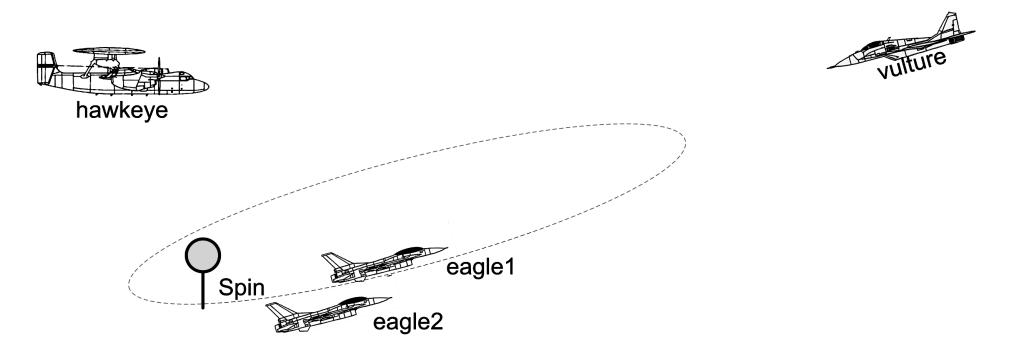
| Claim | Source | Use in lecture | Limit |
|---|---|---|---|
| The chapter surveys expert systems and other application classes. | PDF page 309 | Grounds application breadth. | Lecture synthesis should cite this anchor and avoid replacing the source chapter. |
| The chapter discusses models and modeling. | PDF page 316 | Supports the modeling-practice lens. | Lecture synthesis should cite this anchor and avoid replacing the source chapter. |
| Applications feed into the final conclusion and requirement evaluation. | PDF page 327 | Supports transition to synthesis. | Lecture synthesis should cite this anchor and avoid replacing the source chapter. |
Tensions and assumptions
Where the chapter should provoke careful interpretation.
Applied breadth
Applications show the architecture can leave the laboratory.
A range of domains matters because cognitive architectures claim generality.
Interpretive caution
Application success can depend on model-specific knowledge.
A successful model may reveal as much about engineering effort as about architecture adequacy.
Assumption register
- Lecture explanations paraphrase and synthesize the chapter rather than reproducing it.
- Generated diagrams are instructor-created interpretive diagrams, not copied book figures.
- Claims about modern relevance should be treated as course synthesis unless a later source is added.
Seminar exercise
A concrete activity to turn reading into usable understanding.
Applied task
Choose one application and write a claim-evidence-limit row: what the application supports, what evidence the chapter gives, and what it cannot prove.
Use the source anchors above when defending the answer.
- Which application class best tests generality?Q1
Prepare an answer with at least one source anchor or a clearly labeled inference.
- How much credit should go to Soar versus the task model?Q2
Prepare an answer with at least one source anchor or a clearly labeled inference.
- What kind of application evidence would be most convincing today?Q3
Prepare an answer with at least one source anchor or a clearly labeled inference.
| Moment | Action | Owner |
|---|---|---|
| Before class | Read the chapter note and inspect selected figures. | Student |
| During class | Diagram one mechanism step without notes. | Seminar group |
| After class | Add one claim-evidence-limit row to the course matrix. | Student |
Sources
Trace lecture claims to page anchors, extracted figures, and generated project files.
Reviewed sources
- Chapter 13 - Soar Applications chapter anchor
- Printed start 307; PDF pages 309-326.
- Chapter 13 - Soar Applications opening page
- Primary opening source for the chapter note.
- Chapter 13 - Soar Applications closing page
- End of the chapter page range used for synthesis and review.
- Selected figure 1 from Chapter 13 - Soar Applications
- Extracted image on PDF page 316.
- The chapter surveys expert systems and other application classes.
- Grounds application breadth.
- The chapter discusses models and modeling.
- Supports the modeling-practice lens.
- Applications feed into the final conclusion and requirement evaluation.
- Supports transition to synthesis.