Reading contract
What the chapter note asks the reader to do.
Chapter thesis
Chapter 14 closes the book by returning from mechanisms to architecture-level judgment: Soar's value lies in how its fixed structures, memories, learning systems, and applications answer the requirements introduced at the start.
Review Soar's final architectural assessment against the Chapter 2 requirements, then state which lessons remain persuasive, qualified, or open for modern cognitive architecture work.
Learning objectives
- Summarize Soar from a structural perspective.
- Revisit the Chapter 2 requirement baseline.
- Classify claims as accepted, qualified, or open.
- Extract lessons for contemporary cognitive architectures and AI systems.
Architectural problem
The problem this chapter adds to the course argument.
The course needs a disciplined ending. Without review, the chapters remain a mechanism catalog. Chapter 14 asks whether the whole architecture has earned its claims and where the evidence should be accepted, qualified, or extended.
Key idea 1
The final chapter is an architectural review, not merely a summary.
The conclusion evaluates Soar against explicit requirements.
Key idea 2
Requirements give the closing judgment its structure.
The whole system matters more than any single mechanism.
Key idea 3
Soar's lessons include both specific mechanisms and methodological commitments.
Soar's claims should be situated without reducing them to their era.
Key idea 4
Modern readers should distinguish durable insights from historical implementation choices.
Open questions point toward modern cognitive architecture and AI-agent research.
Mechanism map
A generated diagram and step sequence for the chapter mechanism.
The conclusion evaluates Soar structurally and against architectural requirements. The lecture note should rebuild that evaluation as a review packet, connecting each major requirement to chapters and evidence.
Mechanism sequence
- Return to Soar's structural perspective.
- Reopen the requirement matrix from Chapter 2.
- Map mechanisms and demonstrations to requirements.
- Disposition claims as accepted, qualified, or open.
- Extract transferable lessons for future architectures.
Polymathic lenses
How the chapter reads across cognitive science, AI architecture, learning, memory, and practice.
| Lens | Use in lecture |
|---|---|
| Review | The conclusion evaluates Soar against explicit requirements. |
| Architecture | The whole system matters more than any single mechanism. |
| History | Soar's claims should be situated without reducing them to their era. |
| Future work | Open questions point toward modern cognitive architecture and AI-agent research. |
Figures and evidence
Book figures and page anchors that should ground the lecture.
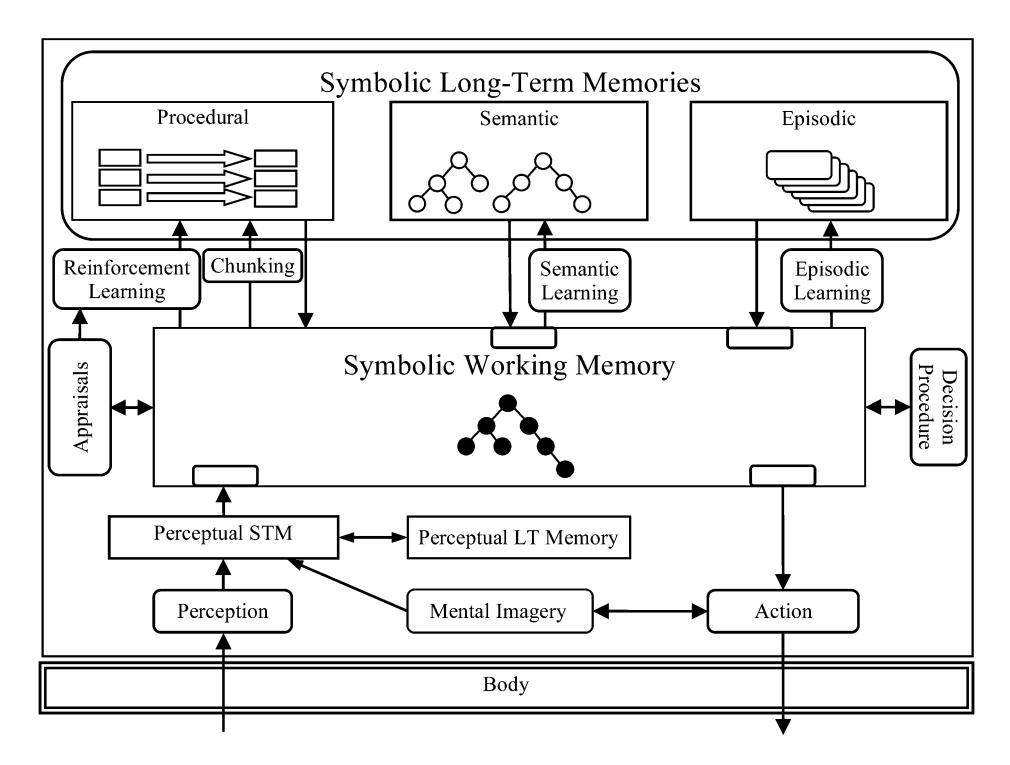
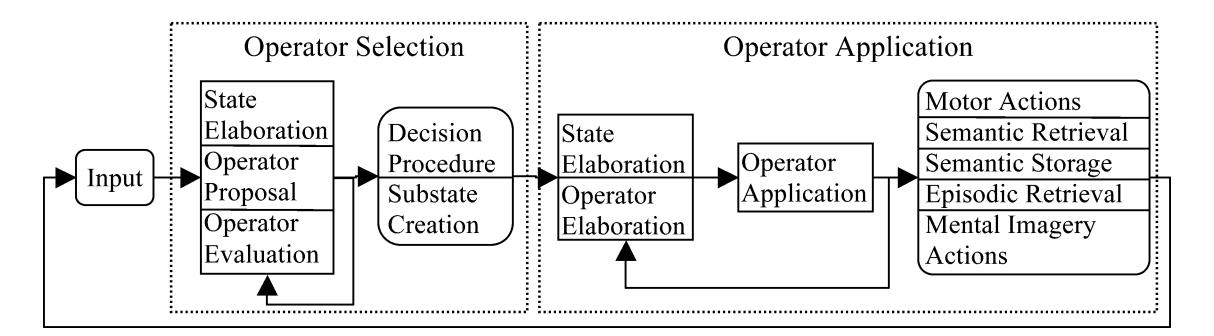
| Claim | Source | Use in lecture | Limit |
|---|---|---|---|
| The chapter presents Soar from a structural perspective. | PDF page 327 | Grounds the review-packet framing. | Lecture synthesis should cite this anchor and avoid replacing the source chapter. |
| The chapter evaluates Soar on architectural requirements. | PDF page 332 | Supports the validation matrix. | Lecture synthesis should cite this anchor and avoid replacing the source chapter. |
| The conclusion closes the course-level synthesis. | PDF page 348 | Supports final disposition. | Lecture synthesis should cite this anchor and avoid replacing the source chapter. |
Tensions and assumptions
Where the chapter should provoke careful interpretation.
Synthesis
The architecture can now be judged as a whole.
The final chapter lets readers integrate mechanisms, memory, learning, applications, and requirements.
Modern reinterpretation
A historical architecture still needs contemporary reading.
The lecture should identify what remains conceptually durable and what may need new evidence or implementation.
Assumption register
- Lecture explanations paraphrase and synthesize the chapter rather than reproducing it.
- Generated diagrams are instructor-created interpretive diagrams, not copied book figures.
- Claims about modern relevance should be treated as course synthesis unless a later source is added.
Seminar exercise
A concrete activity to turn reading into usable understanding.
Applied task
Write a final review memo with three dispositions: one Soar claim accepted, one qualified, and one left open. Each must cite a chapter and PDF page anchor.
Use the source anchors above when defending the answer.
- Which Soar commitment feels most durable today?Q1
Prepare an answer with at least one source anchor or a clearly labeled inference.
- Which requirement remains hardest to evaluate?Q2
Prepare an answer with at least one source anchor or a clearly labeled inference.
- What should a modern architecture borrow from Soar, and what should it replace?Q3
Prepare an answer with at least one source anchor or a clearly labeled inference.
| Moment | Action | Owner |
|---|---|---|
| Before class | Read the chapter note and inspect selected figures. | Student |
| During class | Diagram one mechanism step without notes. | Seminar group |
| After class | Add one claim-evidence-limit row to the course matrix. | Student |
Sources
Trace lecture claims to page anchors, extracted figures, and generated project files.
Reviewed sources
- Chapter 14 - Conclusion chapter anchor
- Printed start 325; PDF pages 327-348.
- Chapter 14 - Conclusion opening page
- Primary opening source for the chapter note.
- Chapter 14 - Conclusion closing page
- End of the chapter page range used for synthesis and review.
- Selected figure 1 from Chapter 14 - Conclusion
- Extracted image on PDF page 328.
- Selected figure 2 from Chapter 14 - Conclusion
- Extracted image on PDF page 332.
- The chapter presents Soar from a structural perspective.
- Grounds the review-packet framing.
- The chapter evaluates Soar on architectural requirements.
- Supports the validation matrix.
- The conclusion closes the course-level synthesis.
- Supports final disposition.